Overview
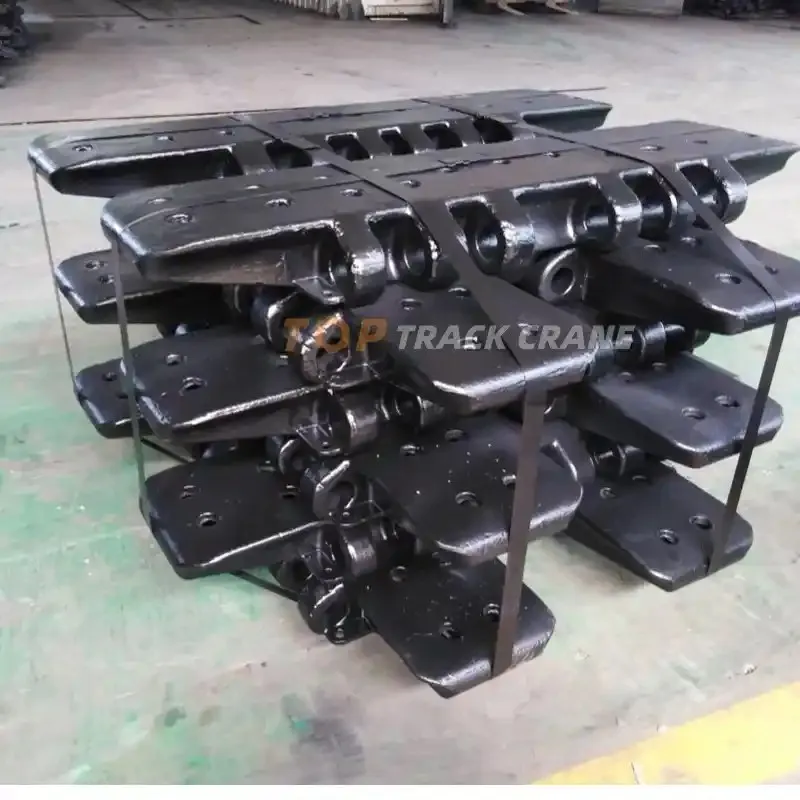
Track plate, also known as track shoe or track pad, is an important component of the undercarriage of crawler cranes. It works with pins, bolts and nuts to make up the crawler crane track assembly.
As the ground-contacting part on crawler cranes, track shoes mainly spread the machine’s total weight and lower the ground pressure. Track shoes take constant impact from gravel and sediment while in operation. This sets high requirements on their hardness, toughness, wear resistance and other key properties.
Processing Technology
1 Casting
Track shoes are normally made with casting methods. Technicians design molds following the technical drawings. Once the sand mold is ready, high-temperature molten alloy steel gets poured into it. The metal then cools and solidifies to form the raw track shoe blank.
2 Rough machining
Next comes rough machining for the track shoes. Machine tools cut away extra material from the track shoe blank and bring the workpiece close to the final finished size. This gets the part ready for later precision machining and heat treatment.
3 Heat Treatment
After rough machining, the track shoes need to undergo a dual heat treatment process including quenching and tempering.This process alters the steel’s hardness and toughness, and greatly boosts the track shoes’ ability to resist impact.
4 Precision Machining
Track shoes receive final precision machining on CNC machine tools. This step improves the workpiece surface quality. More importantly, it holds all dimensions within tight tolerances, keeps mounting holes and flat surfaces accurate, and allows for easy assembly.
5 Surface Quenching
In order to further improve the quality of the track shoes, it is necessary to perform surface quenching on the track shoes. Rapid heating brings the track shoe surface up to the required temperature, followed by fast cooling. This process greatly increases surface hardness and improves wear resistance.
6 Painting
Finally, spray paint the surface of the track shoes to enhance their surface appearance and effectively prevent rust.
Regular Inspection and Replacement
As wearing parts, track shoes require regular inspection and replacement assessment.
Check Points
When inspecting track shoes, start by checking wear on their ground contact surface. Compare against the original thickness to see if wear has neared or hit the limit value.Next, check for cracks around the shoe body and bolt holes. At the same time, check each fixing bolt and nut one by one for looseness, thread stripping or missing threads. Also examine the overall shape of track shoes to spot plastic deformation like bending or twisting on the plate.
Signs for Replacement
Replace track shoes promptly when they wear down to the limit thickness, develop through cracks, suffer heavy deformation, or have stretched and damaged bolt holes that cannot hold a firm fix. Continuing operation with these defects makes the track shoes’ ground contact unstable and reduces traction. Besides that, it causes extra abnormal wear on other undercarriage components including pins and chain links. Over time, the travel system may fail, leading to unplanned crane downtime and extra losses for the project.
How to choose the right track plates?
1 Compatibility
When you select track shoes, you need to treat adaptability as a top priority.Choose track shoes that meet OEM standards. Their bolt hole positions and plate dimensions match perfectly. You won’t need to make extra modifications during installation, so you save both time and labor. It helps avoid different kinds of troubles brought by misalignment during on-site assembly. Picking the right track shoes not only cuts down abnormal wear on the track shoes themselves, but also protects other undercarriage components. It lowers how often you need to replace undercarriage parts, extends the service life of the whole undercarriage travel system, and cuts losses from equipment downtime and maintenance work.
2 Quality
Two main factors decide the quality of track shoes: raw material selection and heat treatment processes.Raw materials form the foundation of track shoe quality. High-grade alloy steel features a well-balanced metal composition, delivering good toughness and wear resistance to stand up to constant impact and rolling on construction sites. If you pick low-grade steel with abundant impurities and inconsistent composition, the track shoes tend to crack and wear out quickly. This speeds up replacement cycles and pushes up operating costs.
3 After-sale Service
After-sales service also counts as a key factor you cannot overlook. If customers run into quality or installation issues with track shoes later on, the after-sales team will step in quickly to help troubleshoot these problems. A dependable after-sales team delivers professional, effective solutions in little time. This cuts down equipment downtime and keeps customer losses to a minimum.
Conclusion
When choosing track shoes, don’t just look at the price. Raw material, heat treatment, fitment and after-sales support all matter. Only when you weigh these together will you pick track shoes that hold up under heavy site loads and cut downtime risk. TopTrack has been in crawler crane undercarriage parts for years. We cast each track shoe from alloy steel matched to the crane’s tonnage and working conditions, with a proven heat treatment process. Our products meet OEM standards and fit most mainstream crawler crane models. Whether it’s Kobelco, Liebherr or any other brand, you can come to us for track shoes and the whole undercarriage package. We’ll recommend the right parts for your working conditions, back them with solid after-sales support, and help you keep maintenance costs down in the long run. Get in touch any time for your spare parts needs.
Previous Post
Next Post